

I was born before PCs, cell phones, and GPS. For most of my time in school, the internet didn’t exist yet. Believe it or not, only a few measly decades ago, we didn’t wear or carry tiny computers wherever we went.
You young ones are thinking I’m old now, but imagine how archaic “wear or carry” will sound in a few decades when you have one implanted in your brain. Eventually, you will be old too. Just you wait.
This is a list of things we had to do before we had tiny computers in our pockets. I wrote it so that you can appreciate how lucky you are.
1. Use maps and ask for directions.
This one actually baffles me and I lived through it. How did we get anywhere without GPS? The answer is, not very easily. We used folded paper maps like 15th century Portuguese explorers. We got lost a lot.
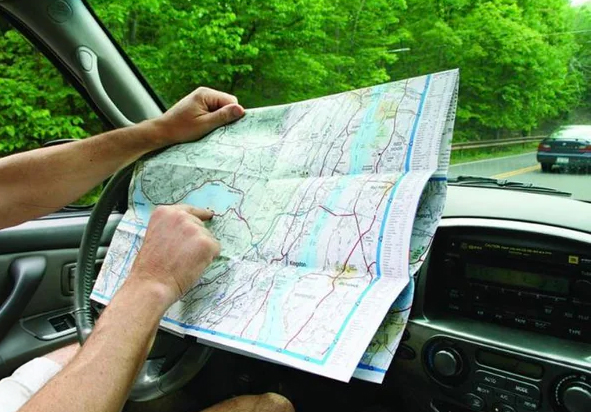
If you were lost, you’d ask for directions at a gas station or from a random person walking down the street. If you knew your destination’s phone number, you could call for directions from a public pay phone.
Going to someone’s house for the first time usually involved writing convoluted directions with landmarks from A to B. For example, here’s the back of a flyer for a friend’s party. The front had all the usual flyer type stuff, but the back was made up pretty much exclusively of directions:

2. Make flyers.
And speaking of flyers, we made them. There was no such thing as online invites or event notifications. The internet did not exist yet. When you were having a party, you had to make physical invitations on paper, which you photocopied and handed out to people in person. I kind of miss this one since a lot of these flyers were very creative:

 Flyers also applied to shows in venues trying to make money:

3. Wait at home for phone calls.
Before pagers and cell phones, most families had one phone number, and that phone number was for every member of your household from your parents to your bratty little sister.
If your parents were tired of you monopolizing the household’s only phone line to talk about nonsense for hours on end, they might spring for a second phone line to be shared by the children. Second lines were especially important once the internet came around since the only way to access it was by phone. More on that later.
If you were waiting for a friend to call, there was a very good chance that someone else in your family would be on the phone, because somehow, they always were. The best chance of success was to schedule a time period: call me between 8 and 10 on Saturday.
In the early to mid 70s, if your sister was on the phone and someone called, they’d get a busy signal, which was basically a series of lower register beeps. If you weren’t home, it would just ring and ring. No call waiting, no voicemail–just a busy signal or ringing forever.
From the late 70s through the 90s, we had answering machines. These were machines with mini cassette tapes inside that a caller could record a message onto, but they were not foolproof.

4. Use libraries for homework.
As mentioned earlier, the internet didn’t exist for most of my school years. When it came to writing school papers, we had to do research the old-fashioned way, i.e., in the library with the Dewey Decimal System, invented by this man:

We’d find the appropriate book using Mr. Dewey’s organization system and either write down notes or photocopy pages from the book.
5. Type on typewriters.
Until word processors became available to consumers in the 90s, essays were either written out by hand or typed on a typewriter. A typewriter is not a computer, it is a machine; all it did was type the letters you punched with your fingers in the order that you punched them.

Typewriters did not have spellcheck, autocorrect, nor check for grammatical mistakes. There was no editing; once you typed something, it was there forever. There was correction fluid to fix mistakes, but it was obvious when you used it.
6. Have pointless arguments.
The Guinness Book Of World Records and other reference books were created to stop pointless arguments. Who holds the record for the longest handstand? Look it up.
Many, many pointless arguments were had before the internet where answers are just seconds away.
“Who played Han Solo in Star Wars?”
“It was Harrison Ford.”
“No, it was Sean Connery.”
“No, you’re wrong. Sean Connery was James Bond. Harrison Ford played Han Solo.”
“No, you’re wrong. Harrison Ford was Indiana Jones, not Han Solo…”
And so it went. Without a third party who knew the answer, sometimes these stupid arguments would escalate or just never get answered.
What is the name of that song? I have no idea.
7. Make mix tapes.
When cassettes tapes first came out, they were life altering. Before cassettes, you couldn’t record your own mixes unless you had an expensive reel to reel equipment.
You could buy pre-recorded albums on cassette, but the real revolution came with blank cassette tapes—simply called “tapes.” You could record anything: songs off the radio, live performances, even your own voice. If you didn’t get it right the first time, you could re-record over it.
Tapes made it possible to create the very first playlists, or as we called them, mix tapes. A mix tape was a custom collection of songs arranged in any order on Side A and Side B. It was like making a playlist today, except cassette tapes usually held 90 minutes of music (though 60- and 120-minute versions existed), so you had to carefully choose what would fit.

A mix tape required careful consideration, because they usually sent a subtle message to the recipient of the tape. Mixes were commonly used as romantic overtures. If a boy liked a girl, he made a mix tape that would delicately get the message across. Making a mix tape is a lost art.
The downside of cassette tapes is that sometimes they would get stuck in a cassette deck or unwind. The best way to fix it was to roll it back up with a pencil.

Eventually, tapes were replaced by compact discs (CDs), but they had the problem of skipping like a record if the surface of the disc was scratched or dirty. Sometimes, CDs would get too damaged to play at all.
8. Buy things.
There was a time when, if you wanted to hear an album and your friend wouldn’t make you a tape of it, you’d have to go out and buy it like a chump. If you wanted to read a comic book and your friend wouldn’t lend you their copy, you bought it. If you wanted to see a movie, you bought a ticket or waited for it to come out on video and rented it.
There was no digital super repository of all of humankind from which to view or download things. A stream was just a continuous flow of people or things; a small river. It was a noun, not a verb.
9. Rent movies from video stores.
If you missed a movie you wanted to see while it was in theaters, you waited a few months until it was released on videotape and you could rent a copy from a video store.
To rent a videotape, you would walk into a brick and mortar location, physically browse aisles of videos, manually pick up a videotape casette, and pay money to a human at the front counter of the store to rent it for a specified period of time. Rental periods were determined by the store; typically one or two days for new releases and up to a week for older films.
Once you had your video, you would go home, insert it into a video cassette recorder (VCR), watch it, and return it to the store within the rental period or accrue a late fee of typically $1 per day. Also, if you didn’t rewind your videocassette back to the beginning when returning it, you’d be charged a fee for that.
If there were no physical copies of the movie you wanted to see in the store, that meant they were all rented out. You’d have to wait for someone else to return it. Sometimes, you could put your name on a waiting list.
In order to rent a video at all, you needed a membership card for the specific video store from which you were renting a movie. It cost money to get a membership cards, sort of like a subscription fee. Also, if you had unpaid fees on your membership card, e.g., for not rewinding, you couldn’t rent anything else until you paid them.

(2warpstoneptune.wordpress.com)
10. Play games at arcades.
Before video game consoles existed, if you wanted to play a new video game, you went to your local arcade armed with pockets full of quarters. You would stand at a big boxy thing squeezed in next to a lot of other big boxy things, put in quarters and play the games in public. Then you’d go home poorer.

11. Change our phone numbers whenever we moved.
Before the late 90s, whenever you moved and even when you switched cell phone providers, you had to get a new phone number. This was rather annoying, especially, if you, like me, moved a lot. People never knew how to get in touch with me and this was before the days of social media.
A friend of mine moved and left his new phone number on my answering machine—except my machine garbled it (I told you they weren’t foolproof). A week or two later, I moved as well, and suddenly neither of us had the other’s contact information. I’ve halfheartedly searched for him over the years, but I never heard from him again. Things don’t always work out like they do in the movies.
12. Wait for pictures to be processed.
There was a time when all pictures and videos were taken with film. Pictures on film had to be physically developed by humans using a series of chemicals. Unless you were a professional photographer, seeing your pictures meant taking them to film processing place where some teenager dumped chemicals on them, and looked through all of your personal memories before you did. And all of this took at least a day.

There were no do overs. You photographed what you photographed. If you didn’t like a picture and wanted to redo it, it was too late. The moment was gone. Your eyes were closed, your hair was a mess, you had red-eye… too bad. It’s printed now.
13. Wait for our favorite television shows to come on.
Prime time was king. All the TV shows in TV land vied for a coveted prime time slot, which was weeknights from 8 to 10 pm when most people had finished dinner and were plunking themselves on the couch for a night of TV viewing.

We were so excited when the VCR came out because it meant that we could record things and watch them later! How cool is that? We can go out and do something while our VCR is busy recording Miami Vice! That’s so radical.
My family got cable when it first came out and HBO, Showtime, and Cinemax only showed second run movies. They didn’t make any programming of their own. MTV actually showed music on television.
14. Write down our contact information.
If you met someone you wanted to talk to later, instead of looking them up on social media, you exchanged phone numbers.
For whatever reason, I saved all the phone numbers I was ever given. I have hundreds of little bits of paper, cocktail napkins, matchbooks, and business cards with handwritten phone numbers on them.
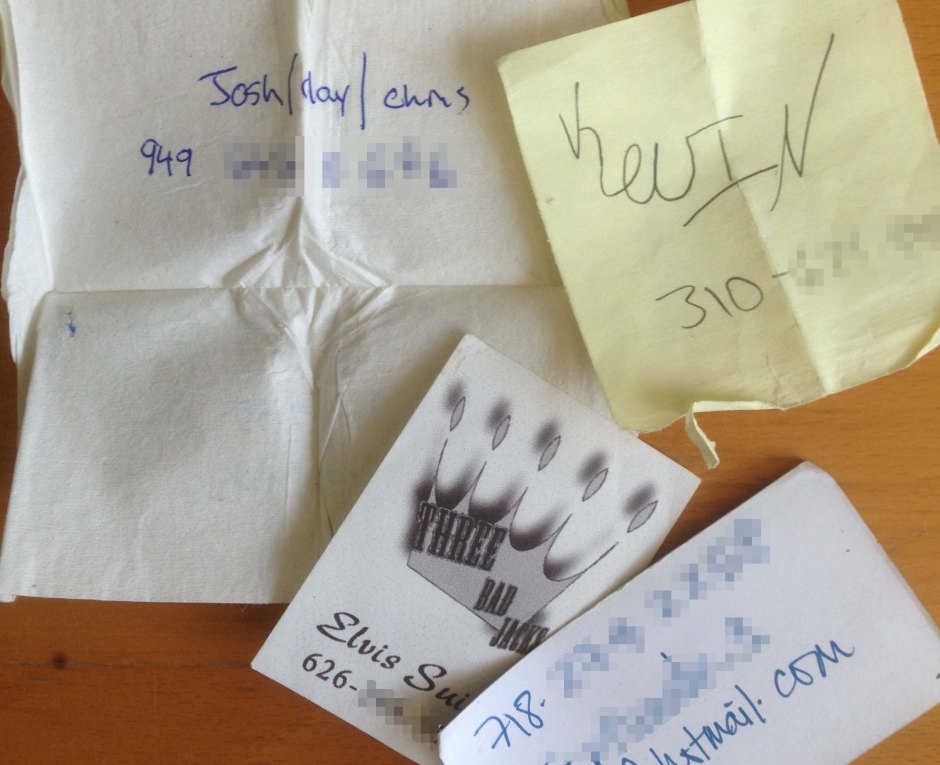
I have some bits of paper that belong to the same person, because everyone kept having to change phone numbers every time they moved. If you lost that bit of paper, you were out of luck. You might never meet that person again since you had no other way to contact them.
 Fish Of Gold