

The Daily Post asked whether I’m a pragmatist or a stickler when it comes to the rules of grammar.
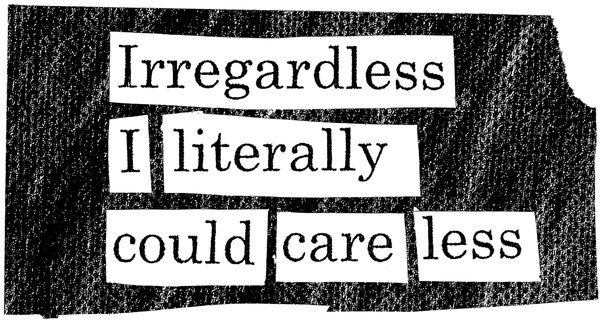
Some might call me a grammar nazi, meaning someone who gets particularly persnickety about the correct application of grammatical procedure and rules. I don’t think I am. I admit that there are certain errors that drive me absolutely batty, but they have less to do with grammar and more to do with lexicon. Just the other day, I wrote about using “I could care less.”
Ending a sentence with a preposition doesn’t bother me, but using the wrong preposition does. Things don’t happen on accident, but by accident (though they do happen on purpose). You cannot be absorbed at your work, but you can be absorbed in it. One does not become accustomed with hot weather, but to it.
While I’m not always clear myself on where the comma goes, or even if one is needed, I rarely use words incorrectly. You know why? Because if I am unsure of how to use a word, I look it up. If I’m somewhere where that isn’t possible, I quickly find a replacement word in my arsenal. For example, if I became a total dolt and wanted to say the phrase “piqued my interest,” but couldn’t remember whether it was peeked, peaked or piqued, I’d simply sub out that phrase with aroused, increased, kindled or I’d just say, “well, that’s interesting.” Done and done.
That’s not to say that I am perfect, because I’m certainly not. There are times where I will reread something I wrote, maybe even something that’s published, and find an error. It’s just that I know enough not to use “irregardless” and its ilk under any circumstances. I have a nasty habit of awkward phrasing. That last sentence originally read “I have a nasty habit of phrasing things awkwardly when I first write them down.” The bulk of the original sentence was unnecessary and added nothing. Most of the editing I do is moving words around and losing the unnecessary filler.
I am not a stickler nor a pedant. Not all sentences are created equal. They don’t always have to have a subject and verb in proper order with no split infinitives and prepositional endings. I don’t even mind fragments when they are used sparingly and to effect. The thing is, this language is full of amazing, beautiful words. There are multiple words for nearly every concept. There are unlimited ways to express yourself, many of which don’t involve mistakenly using the wrong word, split infinitives and prepositional endings. The sheer variety is what makes this language great. It’s yours to explore.
 Fish Of Gold