
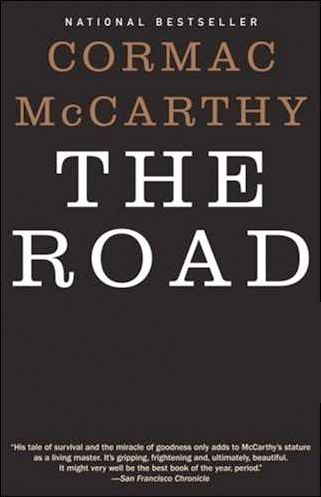
Discuss a book that left you disappointed.
Alright, you asked for it. Based on how popular this book is, I know this will be a very unpopular answer, but the truth is the truth; my interpretation of it anyway.
 Oh, Cormac McCarthy, how do I hate thee? Let me count the ways.
As a qualifier, let me say, I’ve only read 140 pages of Cormac McCarthy’s writing, all of them contained within this book, so I realize that this treatise is wholly unfair and a complete generalization.
I picked this book up because it’s on multiple best seller lists, and has received numerous positive reviews and honors. It was even awarded the 2007 Pulitzer Prize for fiction. Perhaps there are some good recent books out there and I’m missing them, I reasoned.
I cracked the book, not really knowing what to expect. I hated it from the very first page.
I hated it from the VERY FIRST PAGE.
The second sentence in the book starts with “Nights dark beyond darkness.” Umm, that’s terrible. That’s basically the modern equivalent of “It was a dark and stormy night.” I thought to myself that if this sentence continues with ” and days light beyond dayness,” I will burn this damn book right here and now. It was hatred at first read. I nearly stopped reading it right then and there.
The next sentence: “Like the onset of some cold glaucoma dimming away the world.” Guh. It’s a fragment and a simile; a terrible simile, but it’s more creative than “nights dark beyond darkness.”
The next sentence uses the word “precious.”
Still on page numero uno, I’m starting to lather and froth. I’m still in the very first paragraph, mind you. In that paragraph, he talks about a dream he had: “like pilgrims in a fable,” “granitic beast,” “water dripped and sang,” and then, “Tolling in silence the minutes of the earth and the hours and the days of it and the years without cease.” Just how many “ands” are in that sentence with nary a comma to be found?
There’s a dream sequence in the very first paragraph of the book. This can’t get any worse, can it?
At this point, I’m on page two, seething with incredulity. I noticed that I was holding the book farther away from me with every sentence I read, almost at arm’s length, as if I was afraid that its stink would infect me.
Fragment after fragment, I worked my way through this twaddle. I decided to give it as many pages as I could stomach. Alright, read at least 100 pages, I told myself. You can do this. I hated myself for it even as I thought it, but you can’t formulate a proper opinion of a book based on two pages.
Page three: “He said: If he is not the word of God God never spoke.” What’s a “God God?” Have you ever heard of a comma, Cormac?
As if the narrative wasn’t bad enough, then I got to the dialog. I’ve already gathered that he has a distaste for commas, but now, he disregards contractions:
It’s because I wont ever get to drink another one, isnt it?
Ever’s a long time.
Okay, the boy said.
The lack of apostrophes isn’t even consistent. In the same sentence, “it’s” has an apostrophe, but “wont” and “isnt” do not. “Won’t” and “wont” are two different words with different meanings and pronunciations. One is a contraction, the other is a word unto itself. The reason we have apostrophes in contractions is so that we know that it’s a mash up of two words, and we don’t confuse “wont” and “won’t.” Apparently, the rules of grammar do not apply to Cormac McCarthy.
I’m fine with stylistic writing as befits a character. For instance, a character with a southern American accent wouldn’t pronounce a word the same way as someone with a Scottish accent. Spelling a word a different way in order to get the accent across is okay by me. However, using “wont” and “isnt” are not dialect choices; they are stylistic frippery. Did the boy mean that it was his particular habit to not ever “drink another one”? I think not. Cormac McCarthy was just being stylistic for stylistic’s sake.
I found that most of the dialog was just the boy repeating whatever question the man posed, or vice versa, with a period tacked onto the end of the sentence. This is my dramatic interpretation of dialog from The Road:
Im [sic] cold, the boy said.
I know, the man said.
Im [sic] hungry
I’m hungry too
Im [sic] scared
I’m scared too
Are we going to be okay?
We are going to be okay.
Okay
Okay?
Okay
Okay
Thud
Like a champ, I made it through 140 pages. I don’t remember the particular sentence (or run-on/sentence fragment), but when I read it, I literally hurled the book across the room in a fit of pique. Fortunately, it was a paperback.
I patted myself on the back for making it through those extra forty pages. Then, I read the Wiki entry on how it ends. After reading the cheater’s interpretation of the ending, I’m so very glad that I didn’t read the whole thing. If I had, I really might have set it on fire, thereby endangering all the good books on my property.
So, imagine my distaste when I wandered into the public library around the corner from my house to look at the tiny, four-foot wide classics section they have there, only to find this book among such literary giants as Twain, Dickens and Conrad.
I don’t know what defines a classic in the eyes of the public library, but based on age (2006) and quality (see above), this book doesn’t fit. It only fits if you’re going by popularity and that, my friends, is a damn shame.

