

I once wrote:
“The Romans stole most everything from earlier civilizations like Mesopotamia and Egypt anyway. They didn’t invent much of anything except maybe Roman numerals and misogyny.”
Today, I’m delving into some human technological advancements that are typically attributed to Romans even though they did not invent them. I’ll explain who did.
For reference with all the numbers I’m about to drop, the city of Rome was founded in 753 BCE and the Roman Empire came to an end in 1453 CE.
Aqueducts
Romans did NOT invent the aqueduct. Aqueducts had been in use for millennia by the time the Romans came along.
The first Roman aqueduct, the Aqua Appia, was built in 312 BCE, 441 years after Rome was founded. It still exists and it’s quite an impressive construction, but it was not the first.
The oldest known aqueducts date back to the Bronze Age; the Indus civilization in Mohenjo-Daro (2500-1700 BCE) and the Minoans of Crete (ca. 2000 BCE).
One of the oldest surviving aqueducts required every bit as much engineering prowess as the Aqua Appia. The Jerwan aqueduct in modern day Iraq was constructed by the Neo-Assyrian Empire between 703 and 690 BCE. It doesn’t look like much today, but it also had stone arches. It brought water to the city of Ninevah from 31 miles/50 km away. That’s three times longer than the Aqua Appia (10.2 miles/16.4 km long) and it predates anything the Romans built by hundreds of years.

(image credit: Levi Clancy)
Not only did the Romans not invent the aqueduct, but their hydro-technology was actually behind the times.
Concrete
Romans invented Roman concrete, which is a form of concrete that uses volcanic rock. It’s actually stronger than the concrete we use today. In fact, Roman concrete gets stronger as it ages unlike modern concrete, which does the opposite.
That said, the Romans didn’t invent concrete. Thousands of years before the Empire, Stone Age Syrians in 6500 BCE were using a type of concrete to build permanent fire pits.
The first concrete structures were built by Nabataeans who controlled a series of oases in Syria and Jordan ca. 6000 BCE . While Rome was a small collection of huts on a hill, the Nabataeans were using kilns and mortar for the construction of houses, concrete floors, and waterproof cisterns.
The Nabataean city of Petra, built as early as 500 BCE, had concrete-lined waterproof cisterns that were fed by a clay-pipe aqueduct hundreds of years before the Romans conquered the city in 106 CE. The Egyptians, Chinese, Maya, Minoans, and many other civilizations also used concrete long before the Romans.
The Pantheon with its famous concrete dome was built between 27 BCE – 14 CE. Humans had been using concrete for 6,000 years by then.
Roads
The Romans built lots of roads, but they didn’t invent the concept. There was already a dense network of roads in the late pre-Roman era. In fact, The Roman Empire used a lot of roads that already existed. In 500 BCE, Darius I of Persia built a road system that was 1,600 miles/2,575 km, which remained in use during the Roman Empire.
Dating to 4000 BCE, the Sumerian city of Ur in modern day Iraq had stone-paved streets. The oldest surviving paved road is in Egypt, constructed more than a thousand years before Rome was even founded.

(image from dangerousroads.org)
Math & Economics
The Romans invented Roman numerals, but they didn’t invent numbers, mathematics, nor taxation. To the contrary, the Romans actually regressed from advanced mathematics to doing simple calculations on an abacus. Case in point: try doing long division with Roman numerals. The only math Romans cared about was what’s required for plundering, engineering, and taxation.
Humans and Neanderthals have known the basic concepts of mathematics for some 40,000 years. Aside from ancient bones found in Africa with marks believed to be related to arithmetic or astronomy, the earliest mathematical text we currently have is a 4,000 year-old Egyptian tablet.
Greek mathematicians typically get credit for devising modern advanced mathematics. However, the Greeks mainly refined and expanded on Babylonian mathematics. Developed in Mesopotamia around 3000 BCE (ca. 5,000 years ago), Babylonian mathematics included:
Arithmatic
Babylonians used basic arithmetic–except long division. They divided with an equation and a table of reciprocals that produced similar, but less accurate results.
Fractions
They used fractions, but they didn’t have the decimal system.
Square roots
They found square roots using division and averaging.
Measurements
Babylonians invented a cuneiform numbering system with 60 as the base, a system still used to measure angles and time today. Babylonian math is the reason angles have 360 degrees and minutes are 60 seconds with 60 minutes in an hour.
They also measured area, volume, and distance, but not always precisely.
π
Babylonians used 3 or 3.125 (as found on a tablet from 1900-1600 BCE). While they didn’t calculate π correctly, they were aware that they were using an approximation.
Algebra
They used the standard quadratic formula and certain cubic equations based on pre-calculated tables.
Growth
They developed models for exponential growth, constrained growth, and doubling time, i.e., interest rate calculation.
Astronomy
The Babylonians laid the foundations for mathematical and scientific astronomy in other civilizations. Babylonian astronomers kept detailed records of the rising and setting of stars, the motion of the planets, and they calculated the cycle of solar and lunar eclipses–all of which required measuring angular distances on a sphere.
Geometry
Tablets from 350-50 BCE prove that they understood and used geometry earlier than previously thought. They calculated objects in an abstract mathematical space (before the tablets, it was thought to have originated in 14th century Europe).
The Pythagorean theory was in widespread use during the Old Babylonian period (ca. 2000–1600 BCE), over a thousand years before Pythagoras was born. Cultures in Egypt, Nubia, India, and China were using the Pythagorean theorem long before Pythagoras too.
Sewers
Romans often get credit for inventing the first sewage and sanitation systems. They did not. The first example of Roman sewers is the Cloaca Maxima built around 600 BCE. As an aside, the city of Rome was founded about 150 years before the Cloaca Maxima was built. Eww.
The Sumerian city of Eshnunna, built ca. 4000 BCE, had clay sewer pipes. The Hittite city of Hattusa in modern day Turkey had a sewer system with easily detachable segments that allowed for cleaning and replacing. Hattusa was founded ca. 5000 BCE, and was destroyed and abandoned ca. 1200 BCE, which is still a minimum of 600 years before the Cloaca Maxima was built without replaceable parts.
The Roman Cloaca Maxima is very similar to the sewers in The Bronze Age (3300 BCE to 1200 BCE) Minoan city of Knossos on the island of Crete. It had latrines connected with vertical chutes to an elaborate stone sewer system, which again, predate Rome’s by a minimum of 600 years. Still, the Cloaca Maxima wiki linked above says it “was one of the world’s earliest sewage systems.” Uh huh.

(image from toilet-guru.com)
The Nazca in Peru, Mycenaeans, Etruscans, Egyptians, Chinese, and many others had sewer systems before the Cloaca Maxima was built. Basically, most places where people lived in large groups had some form of system to remove waste, that is, until we get to the Dark Ages when Europeans seem to have forgotten everything and literally throw it out a window. Gardyloo!
The Alphabet
The ISO basic Latin alphabet that modern English uses comes from the Roman Latin alphabet, which had 23 out of the 26 letters we use today–it didn’t have J, U, and W. While quite a few Latin letters, words, roots, prefixes, suffixes, etc. have made their way into modern English, the Romans didn’t invent our alphabet.
The Roman alphabet was based on the Old Italic alphabet used by the Etruscans (ancient Italians). That alphabet was taken from the Euboean alphabet (once again, the ancient Greeks), which in turn, was derived from the Phoenician alphabet.
The Legal System
While America’s modern legal system uses words and concepts derived from Latin–e.g., habeas corpus, pro bono, affidavit, subpoena–Romans didn’t invent the law. Going all the way back to the Stone Age, most pre-Roman civilizations had legal systems ranging from “don’t do that” to laws enforced with penalties.
Egyptian law dates as far back as 3000 BCE and was characterized by tradition, social equality, and impartiality. Ur-Nammu, an ancient Sumerian ruler, formulated the oldest surviving law code in ca. 2100 BCE.
In the ruins of Eshnunna in modern day Iraq (also mentioned in the sewer segment above), archaeologists found cuneiform tablets, which are copies of an older source and date back to ca. 1930 BCE. They include this egalitarian gem:
“If a man begat sons, divorced his wife and married another, that man shall be uprooted from the house and property and may go after whom he loves. His wife (on the other hand) she claims the house.”
King Hammurabi, the first king of Babylon who ruled from ca. 1792 – 1750 BCE, was known for his fair laws. The Code of Hammurabi included a wide range of statutes covering family relationships, contracts, inheritances, crimes and punishments, and more.
China, South Asia, and many ancient civilizations also had robust legal systems before the Romans. In fact, much of the Roman legal system (like most everything else Roman) was copied from the Greeks.
Weapons & Military Formations
Romans are known as fierce warriors. Conquering, plundering, and enslaving are what they did best, but their most famous tools of warfare were not their own inventions.
Some famous Roman tools of war are the ballista, a large catapult that hurled either bolts or stones; the scorpio, a torsion crossbow that shot arrow-tipped bolts; siege towers; and military formations like the phalanx.
Catapults
The Egyptian fortress of Buhen seems to contain platforms for catapults dating from ca. 1860 BCE. The earliest recorded catapults date to the 600s BCE when King Uzziah of Judah equipped the walls of Jerusalem with machines that shot “great stones.” The Roman ballista is based on the Greek oxybeles.
Crossbows
Crossbow locks made of cast bronze have been found in China dating to around 650 BCE. The Greeks had a crossbow called the gastraphetes invented sometime prior to 420 BCE when it was first mentioned, which is very similar to the Roman scorpio.
Siege Towers
The Egyptians carved a mobile siege tower in the battle scenes of a tomb at Thebes ca. 2000 BCE. Closer to the Roman Empire, the Assyrian Empire used a siege tower sometime between 884 and 859 BCE.

(image credit: Capillon)
The Phalanx
When people think of Romans in battle, they probably think of them assembled in the tight shield and spear formation, the phalanx.
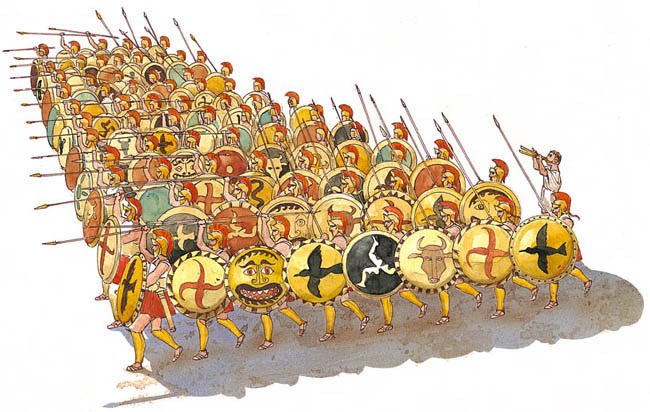
(image from sites.psu.edu)
The earliest known depiction of a phalanx-like formation occurs in the Sumerian Stele of the Vultures from 2600–2350 BCE. The more Romanesque phalanx, with that name and all (first penned by Homer), was famously used by the ancient Greek city-state of Sparta in the Battle of Thermopylae.
Did you ever see the movie 300? Does the phrase “This is Sparta!” ring a bell? Yes, those Spartans led by Leonidas. In reality, there were an estimated 100,000 Persians as opposed to a million, and the 300 Spartans were fighting alongside some 6,000-7,000 allied forces from other parts of ancient Greece. Still, other than the numbers, the historical accounts of that battle are mostly true.
Surgical Tools & Procedures
Humans have been manufacturing surgical instruments since the dawn of pre-history. Rough surgical tools date as far back as the Mesolithic era, ca. 8000 BCE. The oldest surgical procedure for which there is archaeological evidence is Trepanation. That procedure involves drilling a hole in the skull so that evil spirits or demons or other entities making people ill (depending on the culture) would escape the body, thereby making the patient’s headache or other ailment better. Ta-da.
Egypt had professional doctors as early as 5,000 years ago. They used pincers, forceps, spoons, saws, and knives–modern versions of which are used in the medical profession today. Egyptians created the first prosthetics in human history and gave treatments for reproductive gynecological diseases 4,000 years ago.

(image credit: AmazingAncientWorld)
The full name of the C-section we use to deliver babies today is Caesarean section, named after none other than Julius Caesar. Neither Caesar nor the Romans invented it though.
The procedure is most likely named after Caesar, because of the law during his reign that all women who died during childbirth must be cut open to try to save the baby (Romans wanted more Romans). Until modern times, C-sections were only performed when the mother was dead or dying during childbirth, because it would usually kill the mother. Many cultures used it before the Romans.
Roman medical practices, including surgery, were borrowed from the Greeks and many Roman surgeons were actually Greek in origin.
The Calendar
While we still use the names derived from the Julian calendar today, I think we all know that the Romans didn’t invent the calendar. Even though it’s yet another thing named after him, neither Julius Caesar nor the Romans designed it. The Julian calendar was developed by Greek mathematicians and astronomers based on calendars that preceded it.
The first recorded physical calendars dependent on the development of writing were the Bronze Age Egyptian calendar and a Babylonian calendar based on a Sumerian predecessor.
Basically, the only thing the Romans did better than the Greeks was conquer, but just so that this post isn’t entirely “down with the Romans,” here’s a couple of things they did actually invent:
- The codex, the first bound book (ironic since the Romans weren’t big on knowledge for knowledge’s sake)
- Hypocaust, the first under-floor heating (they were big on luxury)
 Fish Of Gold